If you run client experience at a vertical SaaS company, you already have a support team. You've got a ticketing tool, a knowledge base, an escalation path, and probably a customer satisfaction score you're proud of.
Then payroll comes up. It's easy to think of it as one more product for the same team to learn.
Here's the good news: your team has already done the hard part. Good support instincts, good process, good people. Payroll adds a few new skills on top of that. It's not a different job, it's your existing team, learning a new discipline.
The partners who do this best plan for it before go-live, not after. This guide walks through what's different about payroll support, what to build, and how we work with you to get there.
Is payroll support actually different from the support we already run?
Yes, in a few important ways. But different doesn't mean harder. It means applying the same skills to new kinds of problems.
We asked Sam, one of our support leads, about this directly. She worked in HR and workforce support for years before moving to payroll, so she's seen both sides.
On the workforce side, most tickets come from an employee asking someone to explain something: Why didn't I get paid? Why is my onboarding stuck? How do I request time off? The person asking usually isn't the person who caused the problem.
On the payroll side. It's flipped. The person opening the ticket is often the one who ran the payroll or missed a deadline. They're not asking you to explain someone else's issue, they're asking you to help fix something, often with a deadline closing in.
That's a different kind of ticket. One is about explaining. The other is about solving a problem quickly, with real money at stake. Your team can do this, which means building a few things on purpose instead of assuming your current playbook already covers it.
What kind of expertise does payroll actually require?
More than most teams expect, but it's learnable, and we help you build it.
These are the most common tickets, month after month:
- Late payrolls
- Missed deadlines
- Rejected payments (often caused by incorrect employee banking information)
- Tax questions, especially about off-cycle payrolls
Clients often don't realize an off-cycle payroll gets taxed differently than a regular one. That is not something a help article always resolves. It takes someone who understands how payroll tax works.
What does payroll support feel like for your clients?
If you run an HR platform today, your clients are used to a certain kind of support, mostly self-serve, mostly low stakes, mostly "how do I use this feature?" Payroll raises the stakes, because a mistake isn't just inconvenient anymore, which can mean a compliance issue, a real penalty, or an employee who didn't get paid correctly.
That sounds heavy, but it's an opening. Handle it well, and clients notice, which builds trust.
Carla, our Director of Client Experience, put it well: payroll support isn't an "answer the question, close the ticket" job. It's investigative. Say a client's remittance schedule, the schedule for paying employee tax withholdings, gets set up wrong, and payments go out late. You don't just answer that ticket. You find out how it happened, how many payments were affected, whether it can still be fixed, and who's on the hook. That's real problem-solving, not a canned response.
Three levels of payroll support tickets
- Level one, product questions. How do I run an off-cycle payroll? How do I set up a new pay type? Low stakes, usually just a training gap, easy to resolve.
- Level two, day-to-day issues. Someone overpaid an employee and needs to set up a deduction. Someone's asking whether to fix it now or wait until year-end. This is a mix of product help and light compliance guidance.
- Level three, the big ones. A remittance schedule set up wrong. A compliance mistake with a real penalty attached. A client who needs help fast. This is where expertise, not just product knowledge, earns its keep.
Most HR support teams are built and staffed for level one. Payroll means being ready for level two and three as well, on a schedule you don't fully control, because payroll doesn't wait for business hours. That's the one difference worth planning for.
Where should product and compliance questions go after launch?
Product and compliance questions do not always follow the same path. Product questions can start in Nmbr’s docs or Help Center, with a support ticket if the answer is not there. If someone needs access to a restricted resource such as the Sandbox, our support team can help set that up. Nmbr can offer light compliance guidance, while broader legislative questions should go to the payroll expert on your team. If you are building that expertise internally, the National Payroll Institute’s courses are a useful place to start.
How do the support models actually work, and which one is right for us?
This is where many partners get confused, because implementation and support are two separate things.
Implementation is Nmbr-led or Partner-led, which determines who onboards your clients. Support is Nmbr-led or Partner-led, which determines who answers questions once clients are live. You choose these independently, and the combination shapes your whole partner experience.
Under Nmbr-led support, we're the main point of contact. We talk to your clients directly, handle day-to-day resolution, and loop your team in on anything significant. Under Partner-led support, your team is the main point of contact, and we're there for escalations, technical issues, and guidance when something's outside your depth.
Neither model is better, because they solve different problems. If your clients run simpler payroll, smaller businesses, fewer benefit types, no union complexity, Partner-led support can work well, especially once you have some ticket history to learn from. If your clients run more complex payroll, heavy benefits, union rules, multiple entities, it can make sense for Nmbr to support first, so those clients get set up right by people who've already seen the tricky cases. Your team then takes over a clean book of business with real cases to learn from. For a deeper comparison, read our blog: Outsourced vs. in-house payroll support.
Even when partners choose the Partner-led approach and have completed our training, ideally alongside an NPI course, we still like to handle the first 3-5 implementations while your team shadows. From there, you’ll drive and we’ll shadow. After that, you’ve built a strong foundation, and we’re always here if you need us.
Support works similarly. It helps to have us alongside you for the first 5-10 tickets. You can learn from our language, empathy, and expertise, then take the lead with us cc’d.
Are we on our own the moment clients go live?
No, and this is the part most partners don't know to ask about.
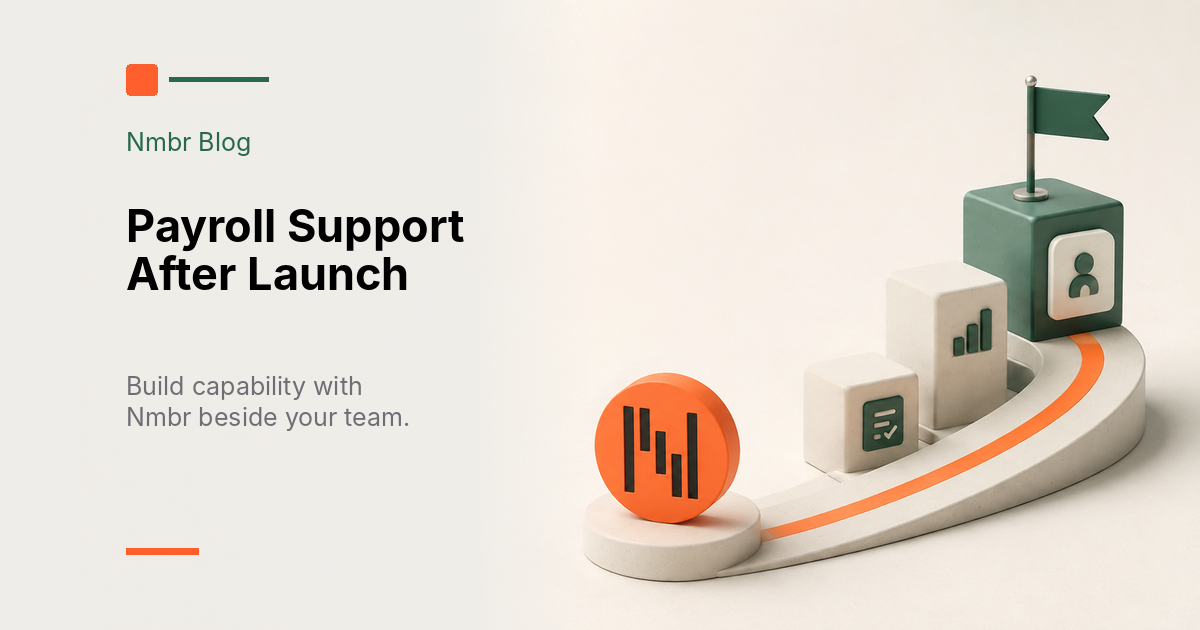
If you've picked Partner-led support, you get an aftercare period, a set window of time that starts once implementation wraps and your team starts handling real tickets. During aftercare, we check in regularly on the tickets your team is handling, help navigate tricky questions, reinforce escalation guidelines, and review your early cases to catch risks before they turn into patterns. You still have full access to our Help Center resources, which we continually update.
What aftercare is not: it's not us quietly staying on as first-line support, and it's not a change to the model you picked. Your team is still the main point of contact for clients at all times. Think of aftercare as a spotter, not a crutch, because it lets your team learn payroll support with someone watching, instead of learning it alone during your first missed remittance.
We've done this in practice, not just on paper. When one partner brought on their first payroll clients, we embedded one of our team members, almost like a full-time staffer, within its support team for a stretch, answering questions directly, side by side, until the partner had someone hired and ready to take over. We trained that person on our process, shadowed and coached them, and today they are fully independent and building a team around the role.
A successful transition looks like: gradual, hands-on, and done when your team is ready, not when a calendar says so.
How do we build this muscle instead of learning it during a fire?
In practice, Carla and Sam from our CX team, approaching it from different vantage points, landed on almost the same practical list, without comparing notes.
- Get your triage right first. Not every ticket is equal, because a blocked payroll is more urgent than a question about customizing a screen. Build your severity levels before you need them, so the team knows instantly what gets dropped-everything attention and what can wait a day.
- Invest in a dedicated ticketing tool. Something that lets you categorize, sort, and track by urgency. This sounds obvious until you're three weeks into payroll support without one, and everything lives in a shared inbox.
- Build your knowledge base before you think you need it. Most teams put this off because it feels like a "someday" project. It turns a simple ticket into something a client solves on their own, which helps reduce repeat questions. Nmbr gives you a starting point. You adapt it to your product and brand.
- Standardize your responses. We learned this ourselves, because everyone on a team writes their own version of an answer, which creates inconsistent quality. Build proven templates for the situations that repeat before the team has to write every answer from scratch.
- Stay close to your own product. Sit in on product calls. Ask questions. Teams that fall behind treat support as an afterthought rather than a source of product feedback. You can't build a workaround for a product's edge case if you don't know where the edge is.
- Use your ticket history. If you've run support-adjacent work under an Nmbr-led model for any stretch, you already have useful data on what kinds of questions come in. That history is worth more than any generic playbook, because it's your clients, not a hypothetical.
Should payroll clients be able to call someone?
Worth deciding on purpose rather than defaulting to it.
A lot of clients want phone support because other vendors have always offered it, but they may not have considered whether it is the best channel; it is simply what they expect. But phone support is a nice-to-have, not a requirement, and it carries real costs: staffing, availability, and the extra work required to track, document, and hand off calls cleanly.
The better question is whether your tooling and staffing can support it without pulling time away from the resources that reduce ticket volume over time, your knowledge base, your self-serve resources, your written response quality. Decide this deliberately, based on what your clients need, not because every other vendor happens to list a phone number.
How do we know when our team is ready to take over payroll support?
You're ready when a few things are true at the same time, not just one of them.
- Your team knows your product's edges, not just its features. Nmbr's payroll API handles almost everything, but your product may not use every capability.
- You have a working triage system and a place to track tickets by severity.
- You have a knowledge base with a clear owner, built from ours and kept current rather than copied once and abandoned.
- You've built response templates for the situations that repeat every month, including late payrolls, remittance questions, and off-cycle tax confusion.
- You've been through at least one aftercare cycle in which we reviewed your real tickets and honestly told you where the gaps were.
If you're missing more than one of these, that's useful information, and it tells you whether you're ready to run support yourselves right now, or whether it makes sense for Nmbr to carry it a little longer while your team builds experience on real cases, with support close by - a spotter in the room.
What is the opportunity in getting payroll support right?
The teams that get payroll support right treat it as its own discipline, with its own ticket levels, tools, escalation logic, and timeline for building skill. The advantage is that you are not starting from scratch. You already have the foundation, the team, the process discipline, and good support instincts. Payroll adds a few new skills on top of what you're already good at.
The difference is that payroll support solves problems rather than just explaining them, moves quickly, and deals with real financial consequences. That makes it higher-stakes and more urgent, so it requires being built deliberately from day one. You can build for that on purpose, starting with the right model, aftercare, triage, and knowledge ownership, and make it a real strength. That's exactly what Nmbr is here to help you build.