If you are adding payroll to your platform, you’ll eventually have to answer a practical question: who is going to help customers get live, run their first payroll, and fix things when something goes wrong?
Payroll isn’t like enabling a new reporting module or launching a lightweight add-on. If the implementation goes wrong, people can get paid incorrectly. Remittances and year-to-date amounts can be off. The CRA, your accounting software, and your payroll software can all end up telling a different story.
If the implementation goes right, clients trust the system, ongoing support is nominal, and payroll becomes one more reason they stay with your platform. The difference is usually whether someone's experience followed a real process.
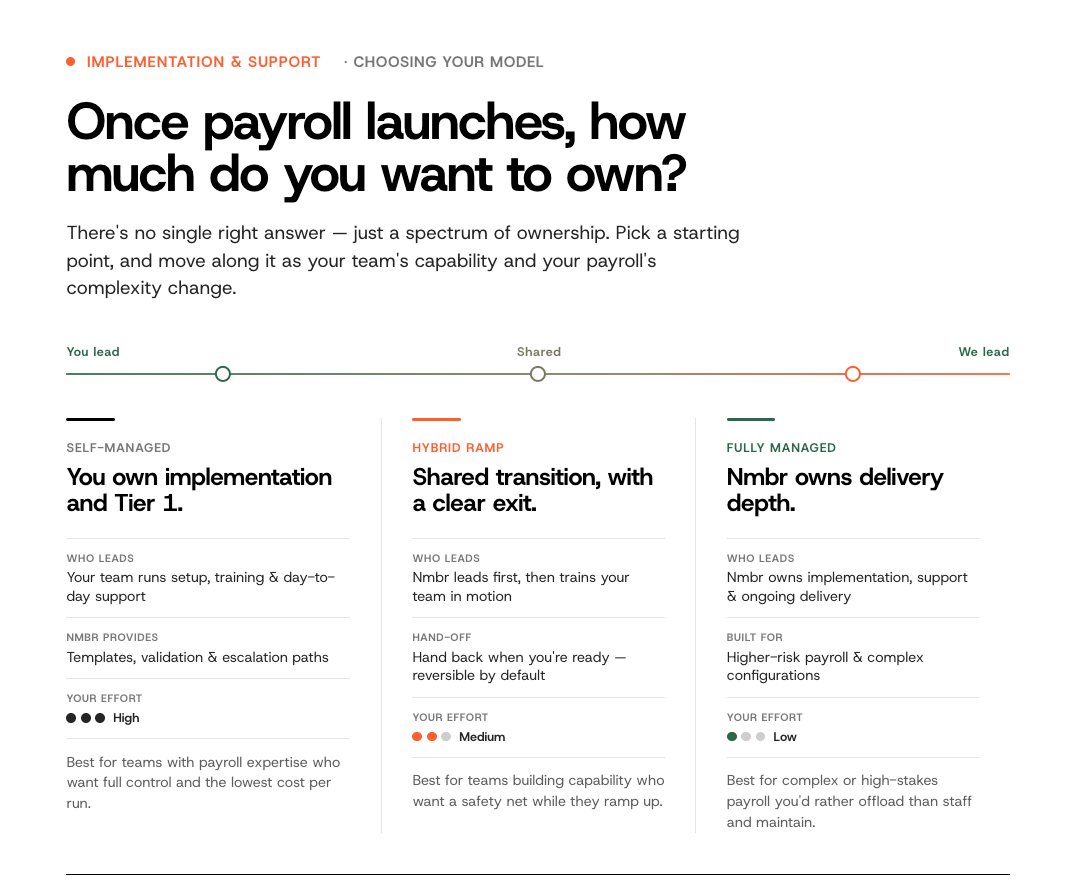
You can own implementation and support from day one, fully outsource it to us, or use a hybrid model in which we own it for a period while your team learns.
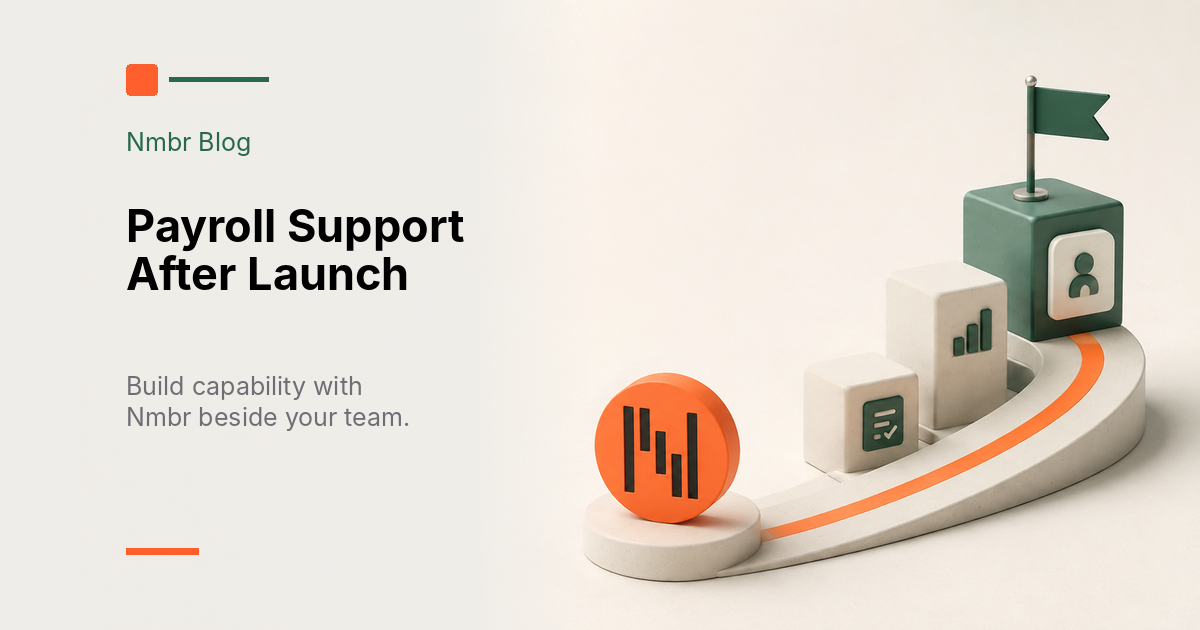
My advice: don’t try to build a fully independent payroll implementation and support team on day one unless you already have real payroll expertise. Instead, let us own the implementation and customer support for a time as you work with us to build your payroll implementation and support muscle.
What makes payroll implementation different from normal product onboarding?
Most of our partners assume payroll implementation is mainly product training: showing the customer where to click, helping them add employees, and walking them through the first payroll run. That part is easy enough.
But that’s not the hard part. The hard part is the data.
Every customer brings payroll history with them. Usually, that starts with a year-to-date report, which shows what has happened in payroll from January 1 to a specific date. That report can include current employees, terminated employees, pay rates, earning types, deductions, benefits, taxable and non-taxable items, pensionable and insurable earnings, union dues, RRSPs, and employer contributions.
The implementation specialist’s job is to accurately import that data into payroll and catch errors before they become payroll problems. When it comes to payroll, there’s no such thing as running it “well” - you screw it up or you don’t. The difference usually comes down to the inputs.
You might receive a spreadsheet with a column labelled "RRSP." But what does that mean in this customer's world? Is it an employee deduction? Is there an employer match? Is it taxable? Does it affect pensionable earnings? Has it already been included in the YTDs? If you guess, you might get through the setup faster. You might also create a problem that only appears when the customer tries to run payroll, or worse, one that sat all year quietly and then showed up when the client needed to issue T4s.
That is why implementing payroll requires a real process. If something is wrong, it sits there quietly, pay period after pay period, all year long, until all of those shavings (errors) show up as a pile when you are processing your year-end.
In practice, a good payroll implementation follows four steps:
- Client onboarding
- Kickoff, discovery and data review
- Configuration
- Set up and validate the environment based on the outcomes from the kickoff and discovery process.
- Import customer’s payroll data
- Dry Run and Training
- Complete a dry run with the client
- Train them on running payroll their way
- Go-live
- Be present for go-live and monitor post-go-live items (e.g. making sure the journal entry syncs with the accounting software, GL codes are mapped properly, etc.)
It’s part product and part process, but the hard parts require payroll judgment, and that only comes with experience.
What work belongs in payroll implementation versus support?
Implementation should own everything required to get the customer through their first successful payroll. That includes discovery, data review, configuration, YTD import and validation, customer education, first-run support, and any setup-related cleanup.
Support should take over after the first payroll has been processed successfully.
That handoff point is important. If you move the customer into general support before the first run, you create a messy experience. The support team may be asked to troubleshoot setup decisions they didn’t make, forcing the customer to repeat the context. The issue bounces around. Nobody owns the outcome.
After the first successful payroll, most support questions become more procedural:
- I missed my payroll deadline. What are my options?
- How do I run an off-cycle payroll?
- How do I correct a bonus payment?
- Why is payroll blocked?
- How do I update an employee's banking information or deductions?
A trained support team can handle those with clear playbooks and an escalation path in place.
But if the question is "why are my year-to-date amounts wrong?" or "why was this benefit taxed incorrectly?" that is probably an implementation issue that escaped into support, and that’s what you want to avoid.
“The strengths of our outcomes are rooted in our process” is a line from the Win Without Pitching Manifesto. In payroll, fewer support tickets usually come from a better implementation process and a stronger, or at least experienced, implementation person.
Should you outsource payroll implementation and support?
Unless you already have payroll expertise in-house, yes, you should outsource it for the time being.
The framework we recommend is the "I do, we do, you do" model. It works because payroll knowledge is hard to absorb from documentation alone. You need to see the weird Excel files. You need to hear the questions customers ask. You need to learn when to stop and clarify, rather than pushing the implementation forward.
There are a few other reasons this makes sense:
- You don’t have experienced payroll operators on your team.
- Your first payroll customers are complex.
- You want to avoid building a full support function before volume justifies it.
- You want to protect the customer experience while your team learns.
The last point there deserves the most attention, and that’s where the Hybrid option comes in. The model is simple: we drive, you shadow. Then you drive, and we shadow. Coaching and skill-building take place during calls. Then, once your team has enough reps, you take it over.
Your team listens, takes notes, and learns what good looks like. Then the model flips. The benefit is that when your team starts leading the calls, one of our experts is still there in the background. The expert can still step in, review the setup, answer offline questions, and catch issues before they become customer-facing problems.
Use experts to protect the first customers. Use those same implementations to train your team. Then bring more of the work in-house once you have proof that the team can handle it.
When should you bring payroll support back in-house?
There are two answers: one financial and one operational.
In the early days of your payroll journey, adoption will be slow. In the pilot phase, you’ll have only one or two customers on board. Then a few more the following month, and a few more the month after that. It usually takes clients three to four months of being live with payroll before they go to general release.
At that stage, there usually isn’t enough work to justify a full-time hire. Most of our partners who have gone the hybrid route have waited until our fees came close to what it would cost them to hire someone full-time for the role, and then they post the job. If helpful, we can help with hiring and then train the person once they are in the seat.
The best implementation people are not just product trainers. They are part project manager, part payroll operator, part customer success person, and part detective. They need to be able to build trust quickly. Customers are nervous during payroll transitions, and that’s normal. Nobody wants to be the person who moved payroll systems and caused employees to be paid incorrectly.
They also need to ask better questions than the customer expects. If a file has an earning code that doesn’t make sense, they can’t just map it to the closest option and move on. They need to ask what it is, how it’s taxed, whether it’s pensionable or insurable, whether it has an employer portion, and whether it has already been included somewhere else. They need enough payroll knowledge to know when something looks wrong.
They also need enough confidence to say, "I do not want to guess on that. Let me confirm it and come back to you by tomorrow."
They also need basic project management discipline: agendas, recaps, action items, deadlines, and clear ownership. Payroll implementations can drift if nobody is driving the process. A good implementation person keeps the customer moving without rushing the decisions that actually need care.
That last one is the real test — can they get the customer through the first payroll successfully?
Once your implementation specialist has those skills and enough real-world experience to handle edge cases without us, it is probably time to bring the work in-house.
Why does the first payroll set the tone?
Customers will not remember the sales call. They will remember whether payroll worked the first time.
A clean implementation, where the data was properly reviewed, the first run went smoothly, and an experienced person was in the room, builds more trust than any feature announcement. A rushed one creates a support queue that traces back to decisions made weeks earlier.
You don't need to build that expertise from scratch on day one. Start with experts leading, your team in the room, and a clear plan for when you take the wheel. That's how you protect your first customers and build the capability to serve the next ones.