Some SaaS products can be sold by charm. Payroll isn’t one of them.
Payroll is technical and sensitive. According to a 2023 PwC Canada report, 54% of employees say that they would consider leaving their organization after two payroll errors. Payroll admins know this, and they treat payroll as high-risk as a result.
Why is selling payroll different?
Selling payroll isn’t like selling a new reporting module or a lightweight add-on. Buyers judge on competence first and features second. Unlike a bad onboarding experience, a payroll error hits people where it hurts most: their finances.
Two things make payroll sales different:
- Errors are costly and emotional: people’s paycheques, taxes, pensions, and government filings are on the line. Mistakes can lead to penalties, employee complaints, and a loss of trust that’s hard to rebuild. In payroll, buyers are not really shopping for features. They are managing risk.
- The status quo is a powerful force: Even when spreadsheets are failing, buyers often prefer the pain they know over the risk they do not. They stick with a known pain rather than gamble on an unknown change. If you are selling payroll, your job isn’t running a slick demo. Your job is to help the buyer define what the right product looks like and how to transition to the product in a mistake-free way.
On the plus side, every business needs to pay its employees. While some businesses can get by running payroll manually, they can only do this if they have a few employees. As a result, as long as you have the features and sales process, you can win a lot of payroll business, and the latter is what we’ll talk about today.
How do assignment selling and a two-call framework help sell payroll?
Assignment selling and a two-call frameworks build certainty.
Most reps push back when I train them on assignment selling and a two-call close: “We do fine with a one-call close process … you want to double the time it takes to close a deal!?”
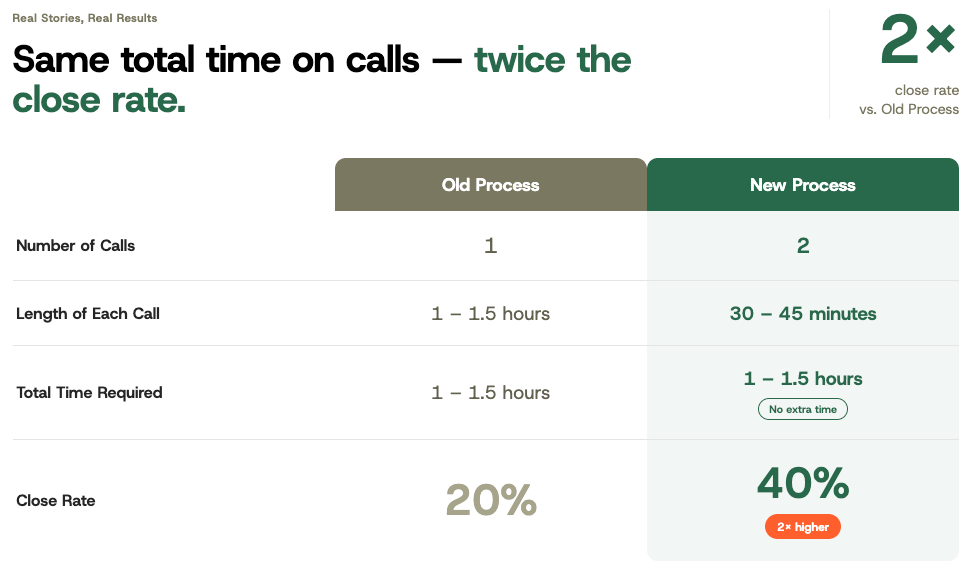
No. I want you to invest the same amount of time, but invest it better:
In the old process, a rep builds rapport, finds pain, demos, talks pricing, asks for the close, and then follows up forever while the prospect disappears. Sometimes this happens over multiple calls, but in SMB-Mid Market Saas, I see it happen more often over one long, drawn-out call.
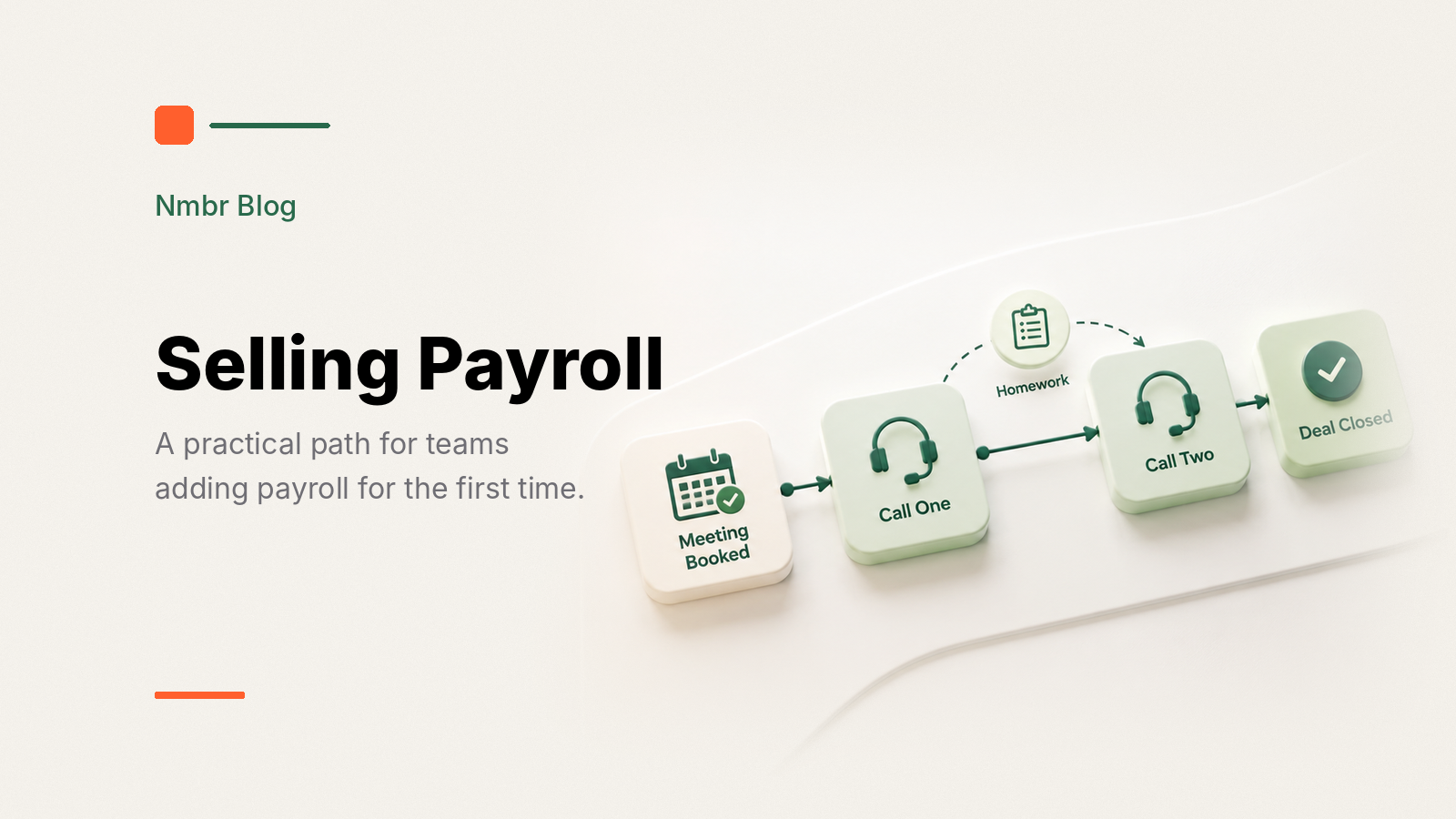
With the new process, you start with one call, the goal of which is to decide whether booking a second call (the decision call) makes sense. You are there to ask questions, assess fit, and demo your product. Your prospect is there to answer questions, watch your demo, and then make two decisions:
- On the first call: whether a second call makes sense
- On the second call: whether to say “yes” or “no” to moving forward with your company.
It takes the same amount of time, but with better outcomes:
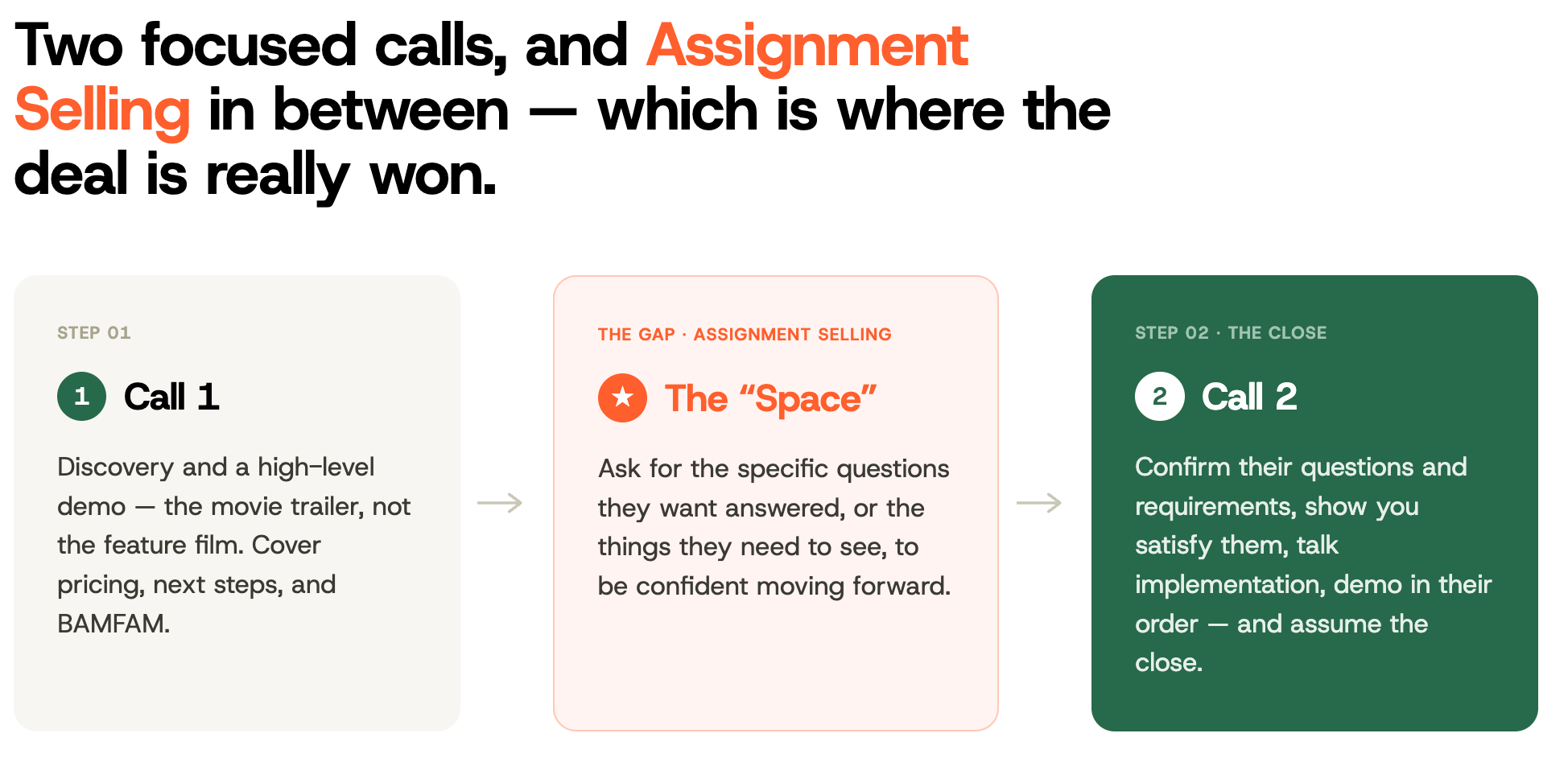
Between call one and two, you kick off the assignment selling process. You give the prospect the task of coming up with the questions they want answered and the features they want to see in greater detail to feel comfortable and confident moving forward. A “yes” is great - everyone loves new clients. But a “no” is good as well - it means you can move on and so can the prospect. What’s not cool is a “maybe.”
From the prospect’s side, they are not entering the demo to admire features. They are trying to answer questions like:
- Can you fully replace our incumbent payroll provider? Why or why not?
- How are payroll taxes, remittances, and government filings handled?
- How do direct deposits, pay stubs, and employee documents work?
- Can you handle our real pay rules?
- What happens when something goes wrong on payroll day?
But in all likelihood, their list is still incomplete, and they need time and guidance to make sure it’s comprehensive.
I liken it to real estate. There’s pain with the existing home and interest in buying a new one, and then there’s “ready to pull the trigger:
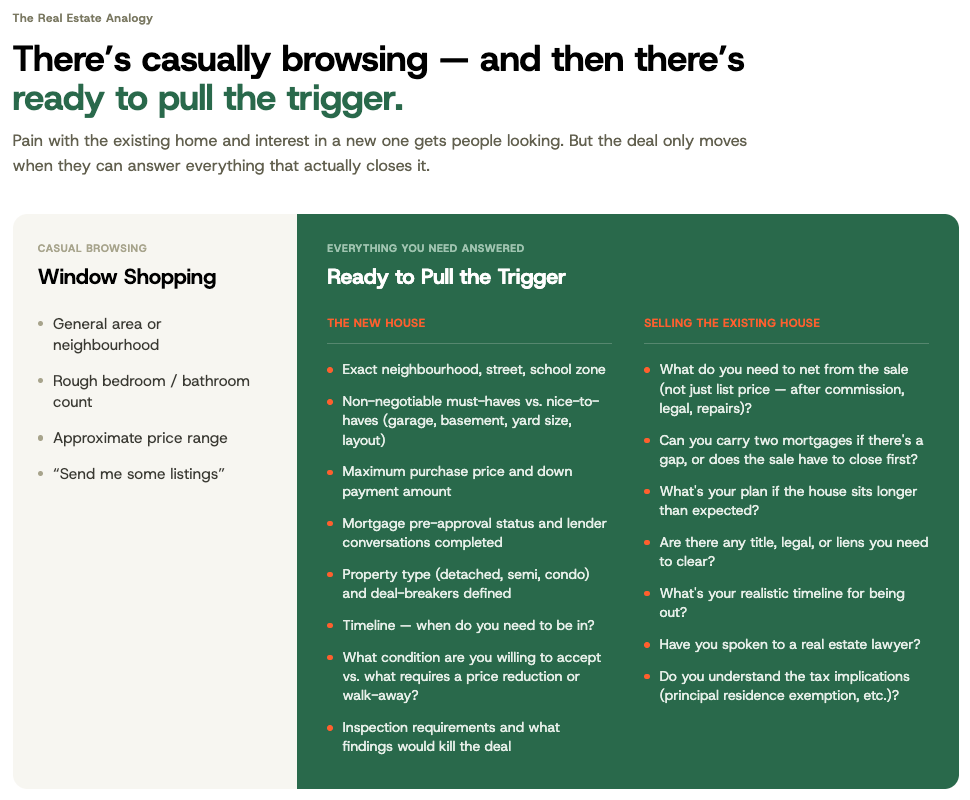
That's the difference between browsing and being ready to decide. Most people show up to demos with the information on the left. Your goal is to give them the time and framework to develop the information on the right.
To lower the risk for the buyer, stop passively demoing and start working through the decision with them. The goal is to make the buyer part of the process, not a passenger on your demo. That’s why you assign homework and give them the space to complete it before the second.
What if your team does not have enough payroll experience yet?
That’s why this is also helpful for people who are new to selling payroll. If the rep manages the clock well, the first call ends before it turns into a payroll pop quiz that they don’t have the answers to. But before call two, the prospect sends the questions they want answered and the workflows they want to see. That gives the rep time to get the right answers and prepare the right demo.
If you’re not sure how to answer a payroll question or demo a specific workflow, don’t fake it. Bring the question back to your team (or our team), and we’ll help you prepare the answer. This is normal. We can record a short walkthrough, share it with your team, and add it to your training resources. Over time, those questions become a training library, and every new rep ramps faster.
What if you do get asked and don’t know the answer? Say you don’t know. Payroll buyers don’t expect every rep to know every edge case, but they do expect honesty. A good answer sounds like: “I don’t want to guess on that because payroll is too important. I’m going to confirm it with our payroll team and bring you the right answer on the next call.”
What does the assignment selling and two-call process look like in practice?
Call one: discovery and movie trailer (30 Minutes)
The first call is not about showing everything in your product. It’s about surfacing pain, demoing your best, and establishing a path forward.
1. Set an Upfront Contract.
Start with clarity. “We have 30 minutes today, and that’s more than enough time for a first call. I’ll want to get a sense of the state of the nation over there when it comes to [the problem you solve] and payroll. From there, we’ll get into a demo, and then we’ll talk through pricing. And really, we are here to see if another call makes sense. We have a ton of awesome features to show you, and we won’t get through them all today, so we’ll get through what we can. Then, I’ll save a couple of minutes at the end to see if you’d like to book another call. Sound good?”
2. Run a good discovery
- When it comes to [your value prop with payroll], how does that work today?
- Where does the data come from before it gets into payroll?
- What happens when something's off?
- How long does that step usually take?
- How often does something go sideways in that process?
- And that's been the process since when?
- How long does that take?
- "So if I'm hearing you right — the real issue isn't the software, it's that [restate their pain]. Is that fair?"
3. Demo the movie trailer, not the full film
When it comes to demoing, you want to do three things:
- Start with your best.
- Demo against their biggest pains first.
- Run out of time.
Most demos I see are feature dumps. They are painful for me as the viewer and worse for the prospect who has to sit through them. There are three common demo styles: the feature walk-through, the problem-solution demo, and the hero’s journey. For this process, we will focus on the problem-solution demo. But first, you need to start with your best.
Every product has two or three things that make buyers lean forward. Don't bury them at the end as a reward for sitting through the demo. Lead with them, whether the prospect asked about them or not. Whatever makes your prospect exhale, show it in the first five minutes.
Then demo using the problem-solution framework. For example, before you enter the scheduling module, repeat the prospect’s problem back in their words and ask if you missed anything. Then, demo the solution against that problem. Not a feature walk-through. A true comparison of the old way and the new way. Show the gap between how they do it today and how your product solves it. You're not walking them through a product - you're showing them what their life looks like when the problem is solved.
Then, run out of time.
I know this seems counterintuitive, but it matters. You want there to be a cliffhanger. Think about every TV show you’ve ever been into. They all end with a cliffhanger. Why? Because the producers want you to crave the next episode. Obviously, a demo is not an HBO show, but the same psychology applies. You want them to want the next call.
From there, book the next call before the first meeting ends (BAMFAM), then start the assignment selling process:
“[Name], I want to make sure the next call is a good use of your time. Before we meet again, can you send me the questions you want answered and the workflows you want to see in more detail, so you have everything you need to decide whether we are the right fit? It doesn’t need to be an RFP. I just want it to be your agenda, not mine, so you leave the call with everything you need. Can you send that over before our next call?”
There are many ways to say this, and you should adjust it based on the buyer. But the message is the same: give them homework so the second call is built around what they need to make a “yes” or “no” decision.
What should the assignment include?
Keep it simple. Ask them to send the questions they need answered, the workflows they want to see, the current payroll problems they want solved, and any must-have requirements from finance, HR, operations, or leadership.
The assignment is not homework for the sake of homework. It gives the prospect time to assess risk and buying criteria, and it gives the rep time to prepare.
Call two: answer the buyer’s agenda (45 Minutes)
The second call isn’t a repeat demo unless new stakeholders are there. If there are new stakeholders, then focus on the demoing features that your champion loved. If it’s the same prospect, the call should be built around the buyer’s homework.
Start by confirming that the list they sent is comprehensive. Answer their questions first. Then, show the workflows they asked to see. Be honest about what the product doesn’t do. Stay true to the problem-soluton framework.
If by the end of the call you’ve answered all their questions well and demoed what they needed to see like a champ, you can assume the close. “So, it looks to me like we check all the boxes. What do you think, should we tie the knot?”
Here’s why I believe in this process:
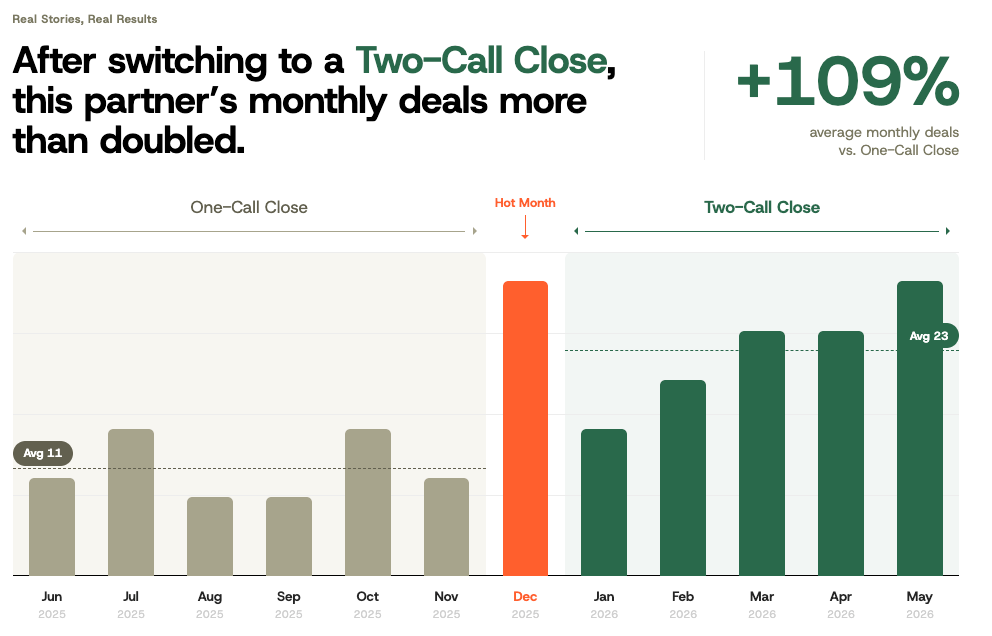
This partner had a product roughly the same, possibly slightly better. But when they moved from a 60- to 90-minute one-call close to a two-call process with assignment selling, they nearly doubled their close rate, and the trend continues upward.
It all comes down to trust and confidence. Payroll buyers need to trust the process, but they need to trust their decision more than anything. With this framework, buyers get the opportunity to think critically about their decision. Reps can learn how to answer questions or demo certain features before the decision call. The outcome is that everyone leaves with a solid understanding of whether this is the right decision for the prospect. This is what enables confident decision-making, and with it, a much higher close rate.