When you hire your first employee, payroll seems simple: they work, and you pay them.
But payroll is about much more than sending money to an employee's bank account.
As an employer, you're responsible for calculating earnings, withholding the correct deductions, paying the employee, remitting taxes to the government, keeping records, and preparing year-end tax slips.
That sounds like a lot, but the process is actually straightforward once you understand the moving parts.
How does payroll work in Canada?
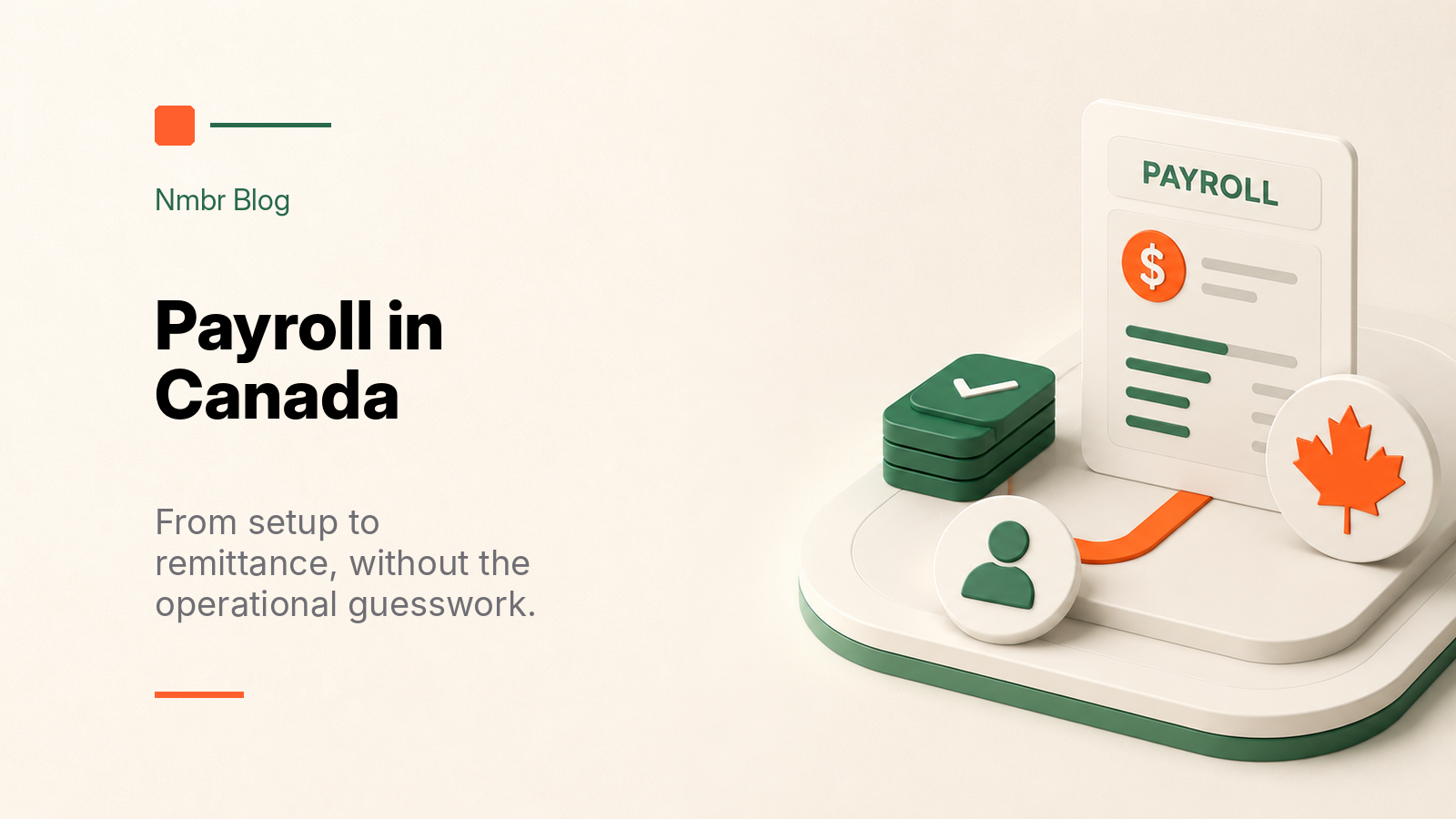
If you remember one thing from this article, remember this - payroll in Canada follows the same basic cycle every pay period:
- Calculate what the employee earned.
- Deduct income tax, CPP or QPP, and EI.
- Pay the employee.
- Remit deductions to the government and keep records.
At year-end, you'll also need to prepare T4 slips so employees can file their personal tax returns.
Let's walk through each step.
How do you set up payroll in Canada?
Step 1: Set Up Payroll Properly
Before you run your first payroll, you need a few things in place.
First, you'll need a payroll account with the Canada Revenue Agency (CRA). If your business already has a Business Number (BN), you'll add a payroll program account, often identified by an "RP" number.
Getting one is straightforward. You can register for a payroll account through the CRA's My Business Account portal, by calling the CRA's business enquiries line, or when you first register your business. If you already have a Business Number, the CRA will simply add a payroll program account to it.
If you have employees in Quebec, payroll has an extra layer. Employers generally deal with both the CRA and Revenu Québec. The CRA handles federal payroll obligations, while Revenu Québec handles Quebec provincial income tax, QPP, QPIP, and other provincial payroll programs.
In Quebec, you'll also need to register as an employer with Revenu Québec so you can remit provincial payroll deductions.
You'll also need to decide how often employees will be paid. In Canada, the most common payroll frequencies are weekly, biweekly, semi-monthly, and monthly.
Biweekly payroll often works well for hourly teams because the pay periods are consistent. Semi-monthly payroll is common for salaried employees because it aligns neatly with monthly accounting. The right choice depends on your team, your cash flow, and how much time you need to collect hours, review payroll, and process payments.
Once you choose a schedule, stick with it. Payroll works best when employees know when they're getting paid, and your team has a consistent process to follow.
Next, you'll need to collect information from your employees, including:
- Full legal name
- Social Insurance Number (SIN)
- Address
- Direct deposit information
Completed federal and provincial (or territorial) TD1 forms, which tell payroll how much tax should be withheld from each employee's pay.
You'll also want to determine whether the worker is an employee or a contractor, as this affects whether payroll deductions need to be withheld at all.
Once you've collected the right information and chosen a pay schedule, you're ready to run payroll.
How do you calculate gross pay?
Step 2: Calculate Gross Pay
Every payroll run starts with one question: how much did the employee earn?
Sometimes that’s simple. If someone is salaried and nothing has changed, the employee’s gross pay may be the same every pay period — but gross pay includes regular pay, bonuses, vacation pay, and taxable benefits and allowances for everyone on the payroll.
For hourly employees, earnings also include overtime and shift premiums, as well as special pay items such as stat pay, vacation paid out upon termination, or honoraria. The total amount earned before deductions is the employee’s “gross pay.” Gross pay is the starting point for everything else in payroll.
What payroll deductions do employers withhold in Canada?
Step 3: Calculate Payroll Deductions
Once gross pay has been calculated, payroll determines how much needs to be withheld. For most employees, there are three main deductions:
Income Tax
Employers are required to withhold income tax and remit it to the government on the employee's behalf. The amount varies based on factors such as:
- Earnings
- Province of employment
- Pay frequency
- TD1 claim amounts
The goal isn't to calculate the employee's final tax bill. Payroll simply estimates the appropriate amount to withhold throughout the year.
CPP or QPP
Employees outside Quebec contribute to the Canada Pension Plan (CPP). Employees in Quebec contribute to the Quebec Pension Plan (QPP). Employers generally match employee CPP or QPP contributions dollar-for-dollar.
Employment Insurance (EI)
Employees also contribute to Employment Insurance (EI). Employers also contribute, typically at 1.4 times the employee contribution.
At the end of this process, you arrive at net pay — the amount the employee actually receives.
How do you pay employees and provide pay statements?
Step 4: Pay Employees
Once deductions have been calculated and payroll has been reviewed, employees can be paid.
Most businesses use direct deposit, although other payment methods are still permitted in some situations. Employees should also receive a pay statement showing:
- Gross earnings
- Deductions
- Net pay
- Pay period information
Before payroll is finalized, it's worth taking a few minutes to review everything. A missing employee, incorrect hours, or a missed bonus is much easier to fix before money moves than after it moves.
How do payroll remittances work?
Step 5: Remit Payroll Deductions
Payroll isn't finished when employees get paid. The deductions withheld from employees don't belong to the employer - they're being held temporarily and must be remitted to the appropriate government agency.
Depending on where your employees work, this may include:
- Federal income tax
- CPP or QPP
- EI
- Employer CPP or QPP contributions
- Employer EI contributions
- QPIP in Quebec
Most employers remit monthly, although some businesses may qualify for different remittance schedules.
Missing remittance deadlines can lead to penalties and interest, so it's important to understand your assigned schedule and build it into your payroll process.
What payroll mistakes should teams watch for?
Most payroll problems don't happen because the calculations are difficult. They happen because a step gets missed.
A few common mistakes include:
Misclassifying Workers
Employees and contractors are not treated the same way for payroll purposes. Employees generally require payroll deductions. Contractors usually do not.
Getting this wrong can become expensive if government agencies later determine that a contractor should have been treated as an employee.
Missing Vacation Pay
Vacation pay requirements vary by province, but employers generally need to track and pay vacation entitlements correctly.
Missing Remittance Deadlines
Late remittances can result in penalties and interest.
Ignoring Taxable Benefits
Certain benefits, allowances, and perks may need to be reported as taxable income.
If they're not tracked properly throughout the year, year-end reporting becomes much more difficult.
Forgetting Records of Employment
When an employee leaves or experiences an interruption in earnings, you may need to issue a Record of Employment (ROE).
Employees often need an ROE to access Employment Insurance benefits. Delays or mistakes can create unnecessary stress for the employee and additional administrative work for the employer.
What employment standards affect payroll in Canada?
Payroll is not only about tax deductions and remittances. Employers also need to follow the employment standards that apply where their employees work. These rules can govern minimum wage, overtime, vacation pay, statutory holidays, termination notice, hours of work, and pay statement requirements.
The rules vary by province and territory, so don't assume what applies in Ontario applies in Quebec, Alberta, or British Columbia.
Before hiring employees in a new province, make sure you understand the local employment standards that apply.
Do you need payroll software to run payroll in Canada?
Technically, payroll can be done manually. In practice, most businesses eventually move to payroll software.
As your team grows, payroll becomes more than just calculating deductions. You're managing direct deposits, vacation balances, employee records, remittances, year-end reporting, and compliance across provinces.
Software doesn't eliminate payroll responsibilities, but it helps reduce mistakes and saves time.
If you only have one or two employees, manual payroll may be manageable. As your team grows, software quickly becomes the safer option.
What should platforms understand before adding payroll?
Final Thoughts
Most business owners overcomplicate payroll. At its core, payroll is a repeatable process: Calculate earnings. Deduct taxes and contributions. Pay employees. Remit deductions. Keep good records.
That's it.
The businesses that struggle with payroll are usually the ones that treat it as an occasional task. The businesses that succeed treat it like a system.
Set it up properly, follow the same process every pay period, and payroll becomes just another business process—not something you lose sleep over.