Embedded payroll is easy to define and hard to launch well.
In a nutshell, it means a platform can offer payroll inside its own product without buying a payroll company or building the whole thing from scratch. “You effectively launch {Your Platform} Payroll, giving your customers a way to run payroll inside the product they already use while creating a new revenue and retention lever for your business.
Specialized infrastructure like ours powers the engine behind the scenes.
That’s the simple version.
The more useful version is this: embedded payroll is a technical and strategic investment in becoming a payroll business through a deep partnership with a company like Nmbr.
Embedded Payroll Is Deeper Than White Label
A lot of people hear embedded payroll and think "white label."
That’s close, but it misses the important part.
Traditional white label often means a separate product with another company's engine and a different skin. Sometimes it’s a clickout. Sometimes it’s a partner portal. Sometimes it’s a payroll product that technically carries your brand but still feels separate from the rest of your platform.
Embedded payroll is different. It means launching your own native payroll within your platform, fully integrated throughout, with your look and feel.
When potential partners reach out to us, they ask questions like “What do your roles and permissions look like?” The answer is: ‘They are your roles and permissions. Our infrastructure supports the experience you already offer because payroll lives inside your platform.’”
That’s the essence of it.
If you look at our API docs, you’ll see this in action through a technical lens. For instance, once a company is created on your platform, it needs to be created in your payroll product through the API request below:
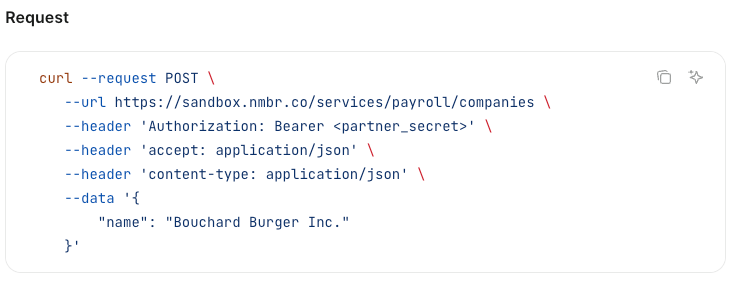
Only then does the company show up inside your native payroll product, either through your custom front-end experience or through our front-end component, as shown below:
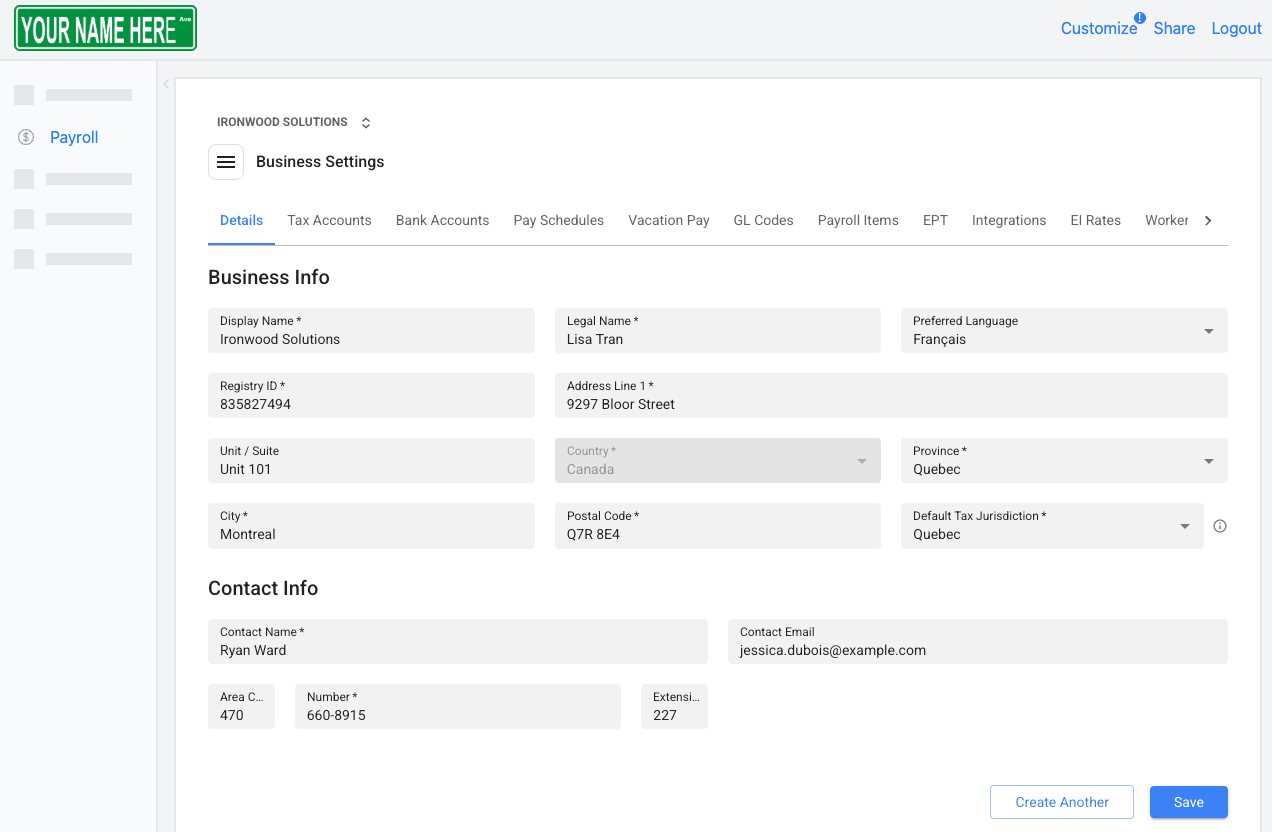
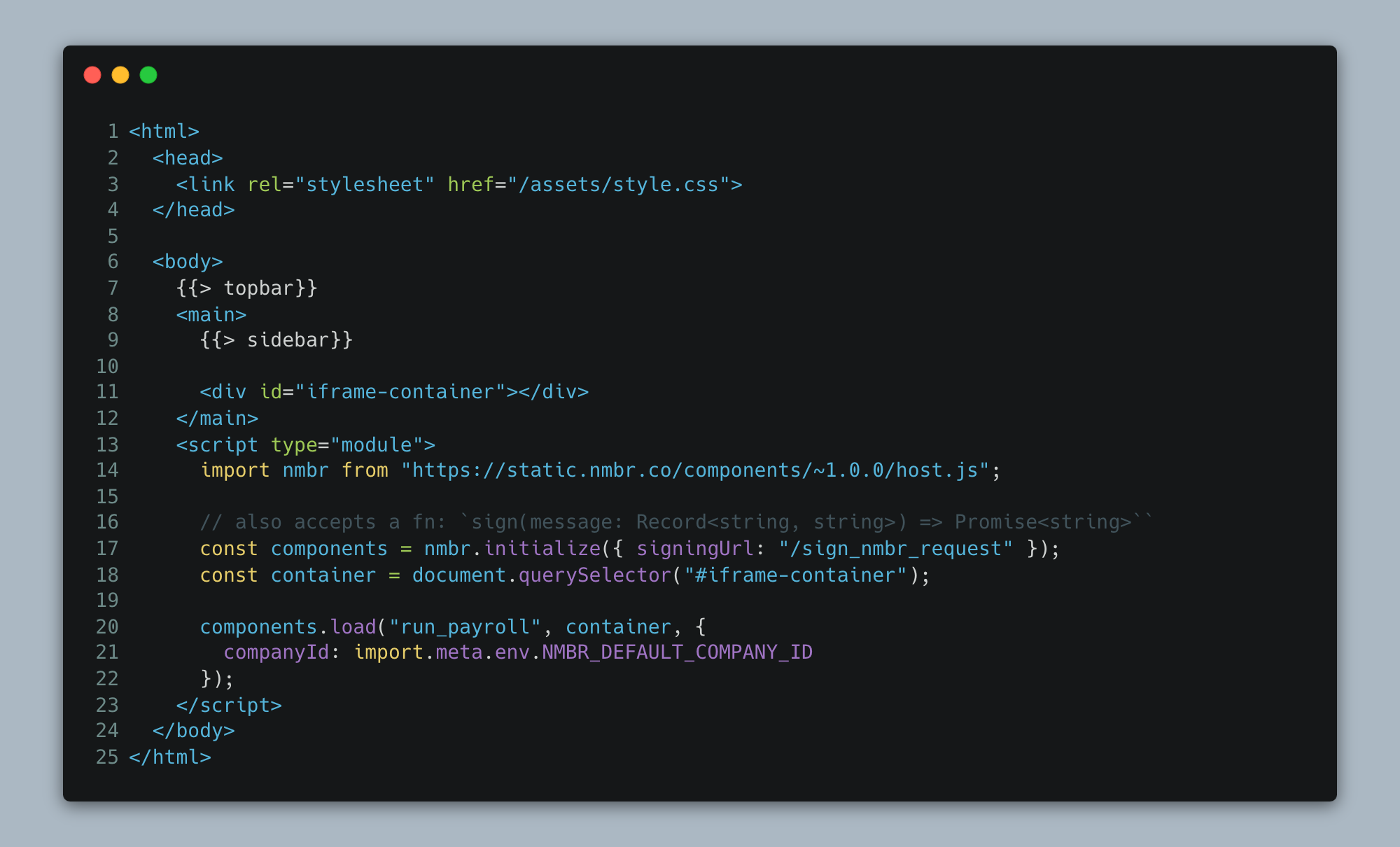
Our front-end component gets you close to a seamless experience with the rest of your platform. You can customize fonts and colours, then place it behind a tab in your left or top navigation called ‘Payroll’ or whatever makes sense for your product. If you wanted to have payroll tomorrow, you would drop in our iFrame and you can have payroll quickly.
The problem is that it would be blank:
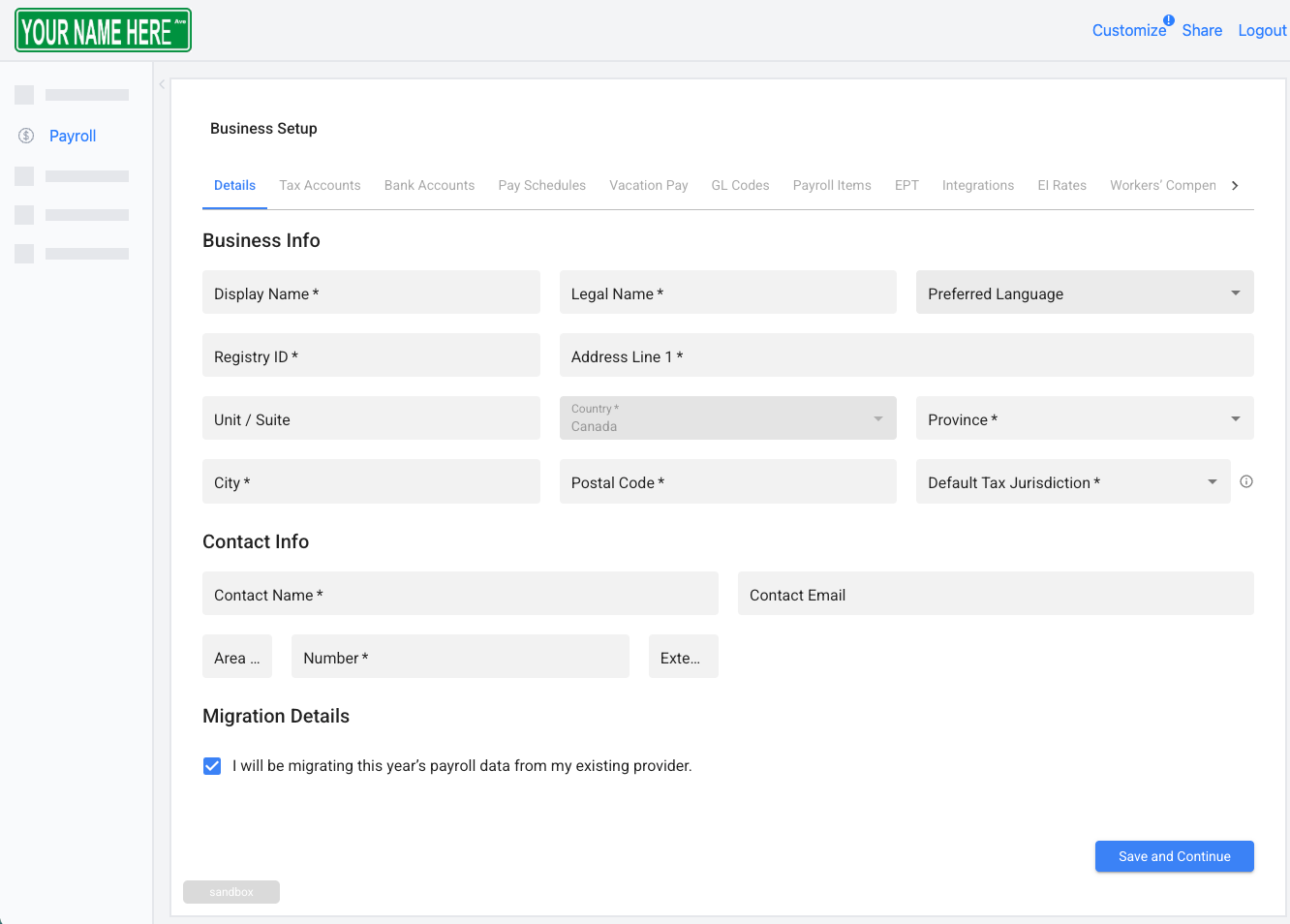
There would be no business info, no employee data, just an empty payroll. That is not a value proposition that wins much business. That is where the integration comes in.
The core value of an all-in-one platform is eliminating duplicate data entry. When an employee is created on your platform, they are created in payroll. When hours are approved, they pass to payroll. Your clients never need to know that, behind the scenes, creating that employee triggered an API request like this:
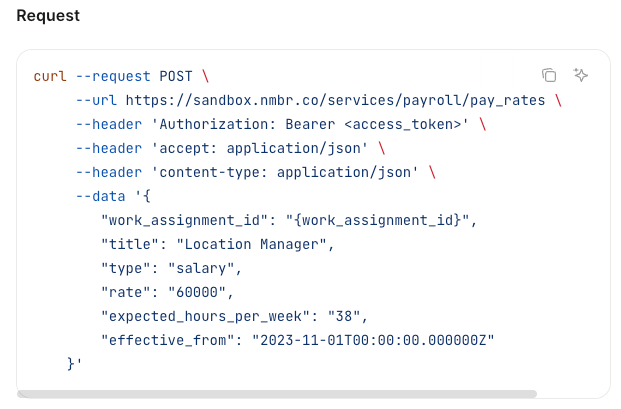
All they know is that they now have one partner instead of two. They get more value from the platform they already use, and they save time because changes in one system do not need to be exported, re-uploaded, and double-checked somewhere else. They get more time and fewer headaches, which is the whole point.
Why Platforms Start Looking At Payroll
Most platform teams don’t wake up one day and decide they need "embedded payroll."
They get pulled there by the workflow.
A workforce management platform already manages employee profiles, time tracking, scheduling, pay rates, and other data payroll depends on. Eventually, their prospects or customers start to ask: "How do we get this data into ADP?"
So, your product team builds a CSV export to ADP, or an API integration.
Then, a salesperson comes to your product team and says, ‘We have a huge opportunity, but we need an integration with Dayforce.’ So that gets built. So that gets built. Then UKG. Then Payworks. Then Nethris. Eventually, you are managing multiple integrations with third-party payroll providers.
Meanwhile, those same payroll providers offer many of the tools you do: time tracking, employee profiles, scheduling, and more. And they are actively trying to win the workforce management side of your customers’ business. So, you are forced to innovate. You build a better and better workforce management platform to make it more difficult for your clients to leave. Eventually, your product is far better than the tools offered by the payroll provider on the workforce side, and you ask yourself: “what if we also offered payroll?”
- Integrations with third-party providers? A thing of the past. Or, at minimum: ‘We offer an export, but we can’t guarantee ADP won’t change something on their end. Why not use our payroll instead? It’s fully integrated.’
- Payroll providers trying to win your workforce customers away? Less of a threat.
- Sending all that payroll revenue to the payroll provider? Not anymore.
- Sending a market signal that you are an all-in-one? Check
Data Integrity and the Real Value Prop
Payroll admins don’t double-check spreadsheets because they enjoy the work. They do it because the cost of being wrong is high.
If approved hours or pay rates do not sync accurately, or employees are underpaid, overpaid, or not paid at all, ‘sorry’ is not enough. The impact on employees is high, the impact on culture is higher, and cleaning it up across the CRA, accounting, and payroll becomes painful fast.
So what do payroll admins do even after the data is passed to the payroll provider through a CSV export or API?
They manually check every single line item against the source of truth (your platform, most likely) to ensure these mistakes don’t get made.
So yes, your ADP integration is a solid sales tool. But once the admin is exporting payroll data from one system to another, then checking it line by line for accuracy, the question becomes obvious: ‘Wouldn’t this be easier if one system did everything?’
That is when they start the search, ask for budget, or reply to the friendly Dayforce salesperson who has been following up with the competitive version of your product.
You are already the trusted operating system. You are already the source of truth. Customers want fewer systems, not more. They want more from the product they already use. Underneath it all, the value comes down to removing duplicate data entry. Do that, and you have a real payroll story.
The Options: Buy, Build, Refer/Integrate, Or Embed
So, if native payroll is the opportunity, how do you get there?
You can buy a payroll company.
That gives you control, but it also gives you the operating burden. You are taking on the product, people, compliance, support, customer promises, legacy decisions, and probably legacy code too.
You can build payroll yourself. But “payroll” is a deceptively small word for a very large system.
It is a regulated operating system for moving money, calculating employment obligations, filing with government agencies, maintaining employer records, and handling edge cases that never stop coming. You need jurisdiction mapping, deductions, benefits, garnishments, direct deposit, remittances, filings, notices, amendments, year-end forms, reversals, corrections, audit trails, permissions, approvals, support workflows, ongoing compliance updates, and plenty of other boring words. There is a reason we are called The Nmbr Company.
As a result, most platforms start by integrating with payroll providers. That gives them a payroll ‘offering,’ because without one they lose deals. But then they run into the scenario above: managing multiple integrations while your customers spot-check every piece of data for accuracy and quietly wonder whether another platform would make this easier.
You can refer customers to an outside payroll provider and accept that payroll lives outside your product.
Or, you can embed payroll.
That means launching payroll inside your own experience, powered by a partner that has already spent years building the boring, compliance-heavy infrastructure. You get the outcome of native payroll without buying a company or building the whole thing from scratch.
None of these options is automatically right.
The decision comes down to what you want to own.
Product Decisions
Embedded payroll is often described as a technical category. APIs, components, iFrames, data models, webhooks, payroll objects, and infrastructure all matter.
But the technical path is also a business decision, and a lot of that decision comes down to the front end.
On the backend, the goal is straightforward: map the data your platform already stores, pass it into payroll, and remove duplicate data entry wherever possible. The only things that should live only in {Your Platform} Payroll are the things your core platform does not already store, or the things that are genuinely payroll-specific.
That way, an employee profile in payroll that used to look like the screenshot below, with every little payroll-related detail under the sun:
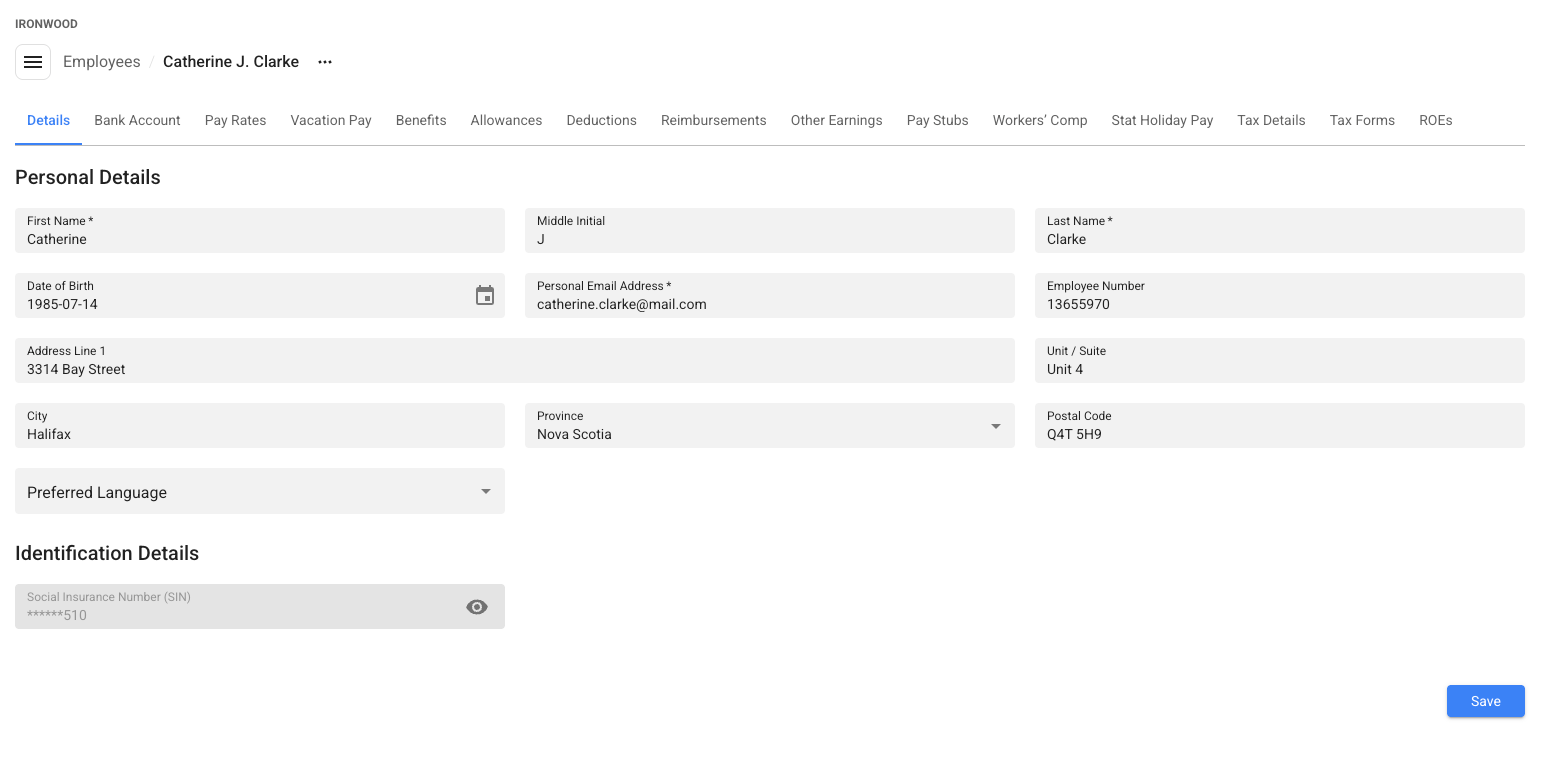
Can turns into this:
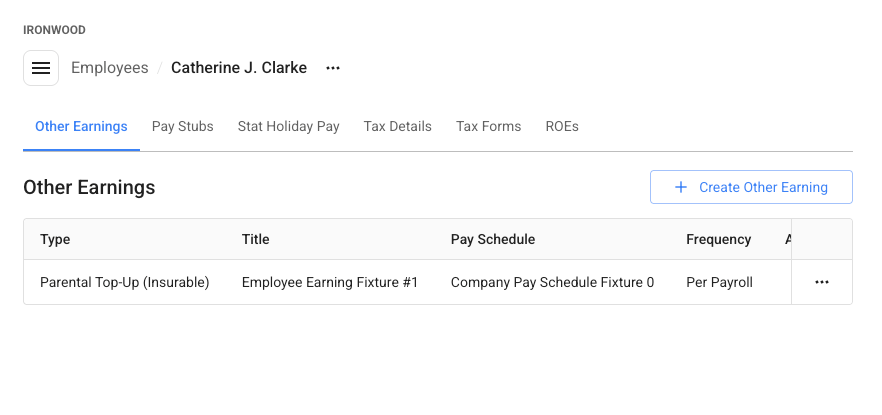
… Just the payroll-specific stuff. Or maybe there is no separate employee profile in payroll at all, because pay stubs, tax forms, and other payroll-related items sync back to the employee profile in your platform.
From there, the front-end decision comes down to this: custom or component?
If you have the resources, experience, product chops, and time, custom is the best experience. There is nothing better than a thoughtful UI built from months of customer feedback, shaped around your ideal customer profile, and aligned with the rest of your platform. There is also the risk that you do not get it right, which is where product judgment matters.
That is why most of our clients choose the component route. It’s like embedding Stripe, but for Canadian payroll.
Create a tab in the left nav, call it Payroll, and drop in the iFrame:
And you have payroll inside your product:
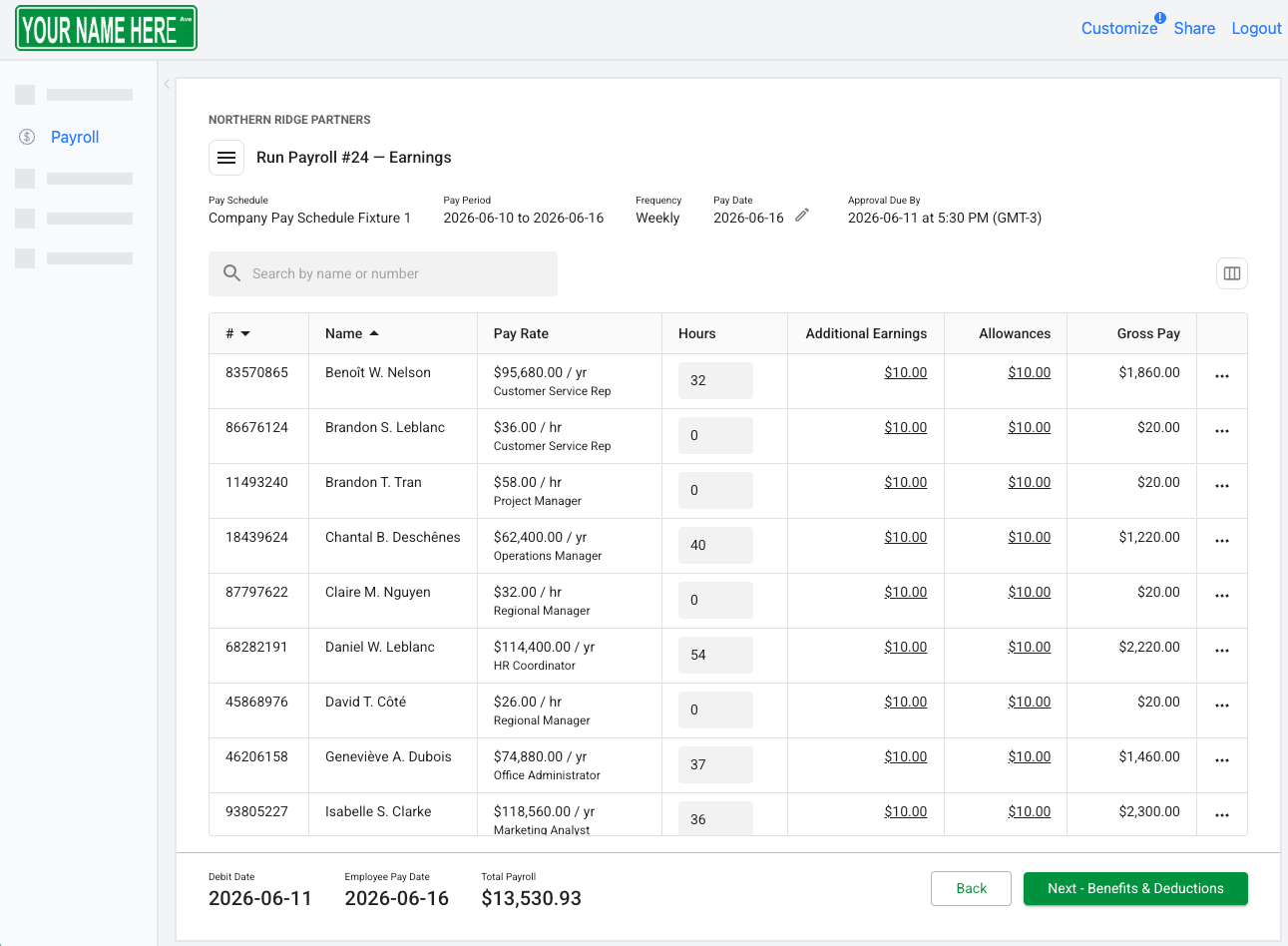
The component doesn’t have to be all-or-nothing. You are not tied to it forever, and it does not need to own the entire payroll experience. Want to design your own reporting dashboard or pull payroll reports into your existing reporting tool? Do it. You can disable the reporting module in the embedded experience and own that workflow yourself. This path lets you start with best practices, collect customer feedback, and decide later where a custom front end creates real value. If you eventually build your own experience, you are doing it with months or years of usage behind you, and with confidence that payroll is becoming a meaningful part of your business.
Why Vertical SaaS Is A Strong Fit
Vertical SaaS platforms often have an advantage because they understand their industry’s workflows better than a generic payroll provider does.
That matters.
The best payroll product for a construction workforce platform probably does not look like the best payroll product for an HR platform, an accounting platform, or a bank. The workflows are different. The customer's language is different. The support questions are different. The sales story is different.
If your platform already understands the customer's hiring model, job structure, schedule, location rules, onboarding flows, or overtime rules, payroll can become more than a generic add-on. It can reflect how that industry actually works.
That is where payroll can become defensible.
Not because the platform says ‘we have payroll’ on a feature page, but because the payroll experience connects to the workflow the customer already cares about.
For some platforms, a first version is enough to prove demand. For others, the ability to build industry-specific payroll experiences over time, using what the platform already knows about its customers, is a massive advantage. If a construction workforce platform is demoing a customer that files 600 ROEs every fall, and it shows a bulk ROE workflow that can do the job in five minutes, the salesperson probably doesn’t need to demo much else.
The Partnership Has To Go Beyond Tech
A payroll API changes the build path, but it does not automatically make your team good at selling, launching, or supporting payroll.
That takes messaging, waitlists, in-app upsells, customer education, sales materials, demo flow, objection handling, implementation planning, support training, roadmap conversations, and a clear view of which customers should be first.
The best embedded payroll partnerships go beyond technology because payroll does not succeed just because the API works.
It succeeds when the platform can explain the product, sell it to the right customers, onboard them, support the workflow, and keep improving the experience.
That’s especially true for teams that want payroll to become part of the platform's identity. If you want to be the all-in-one operating system for your market, payroll has to feel like part of that promise. It cannot feel like a vendor link hiding under a new tab.
A Simple Way To Think About Embedded Payroll
If you need one sentence, use this:
Embedded payroll lets a platform offer payroll inside the product its customers already use, while specialized payroll infrastructure supports the workflows behind the experience.
That definition keeps the important pieces in view:
- The customer stays on your platform.
- Payroll becomes part of the product strategy.
- Infrastructure powers the engine behind the experience.
- The platform still needs to decide what it owns.
For a platform buyer, that is the difference between "we know a payroll provider" and "payroll belongs in our product."